

 PQC
PQC
As a businessman/woman, what does security look like to you? Are the most important or valuable pieces of data in your company safe?
The blueprints of a new building or the source code of new software your company is working on, are these safe? A pending M&A file or your clinic’s patient records; are these safe?
There is another question: if the most important data in your company was copied off your servers today, but the hacker/attacker can only decrypt it after five or six years, would you still call it “safe”?
Security researchers call this Harvest Now, Decrypt Later,” collecting encrypted data today with the expectation of decrypting it once quantum computers are capable enough. Big names like IBM treat this as a real and actively discussed risk category.
The threat of decoding your data in 10 years is not coming in 5 years or so.
This is where post-quantum cryptography, or PQC, comes in. PQC basically helps provide companies with quantum-safe encryption standards that assist companies like yours in withstanding an upcoming attack.
The winning companies are treating this threat as IT modernization right now. They started earlier than many, and this is why they will be able to keep their data secure for a long, long time.
The Business Case, Not Just the Tech Case
Shelf life matters. If your data must stay confidential for at the very least more than 5 years, just understand that your runway is not like that of an airport. If you are working on biotech patents or defense classification, this is it; start working on the transition right now.
The regulatory timeline is staged, not a cliff.
| Standard | Milestone | Deadline |
|---|---|---|
| NIST IR 8547 | Deprecate RSA-2048 / ECC P-256 and other 112-bit quantum-vulnerable public-key cryptography. | After 2030 |
| NIST IR 8547 | Disallow quantum-vulnerable public-key cryptography. | After 2035 |
| NSA CNSA 2.0 | New National Security Systems (NSS) acquisitions must be CNSA 2.0 compliant | Jan. 1, 2027 |
| NSA CNSA 2.0 | Equipment/services unable to support CNSA 2.0 must be phased out | Dec. 31, 2030 |
| NSA CNSA 2.0 | CNSA 2.0 algorithms mandated; vast majority of NSS cryptography is expected to be quantum-resistant. | Dec. 31, 2031 |
| NSA / NSM-10 | All National Security Systems intended to be quantum-resistant. | 2035 |
NIST IR 8547 and NSA's CNSA 2.0 FAQ.
Here is a little display to make it clearer:
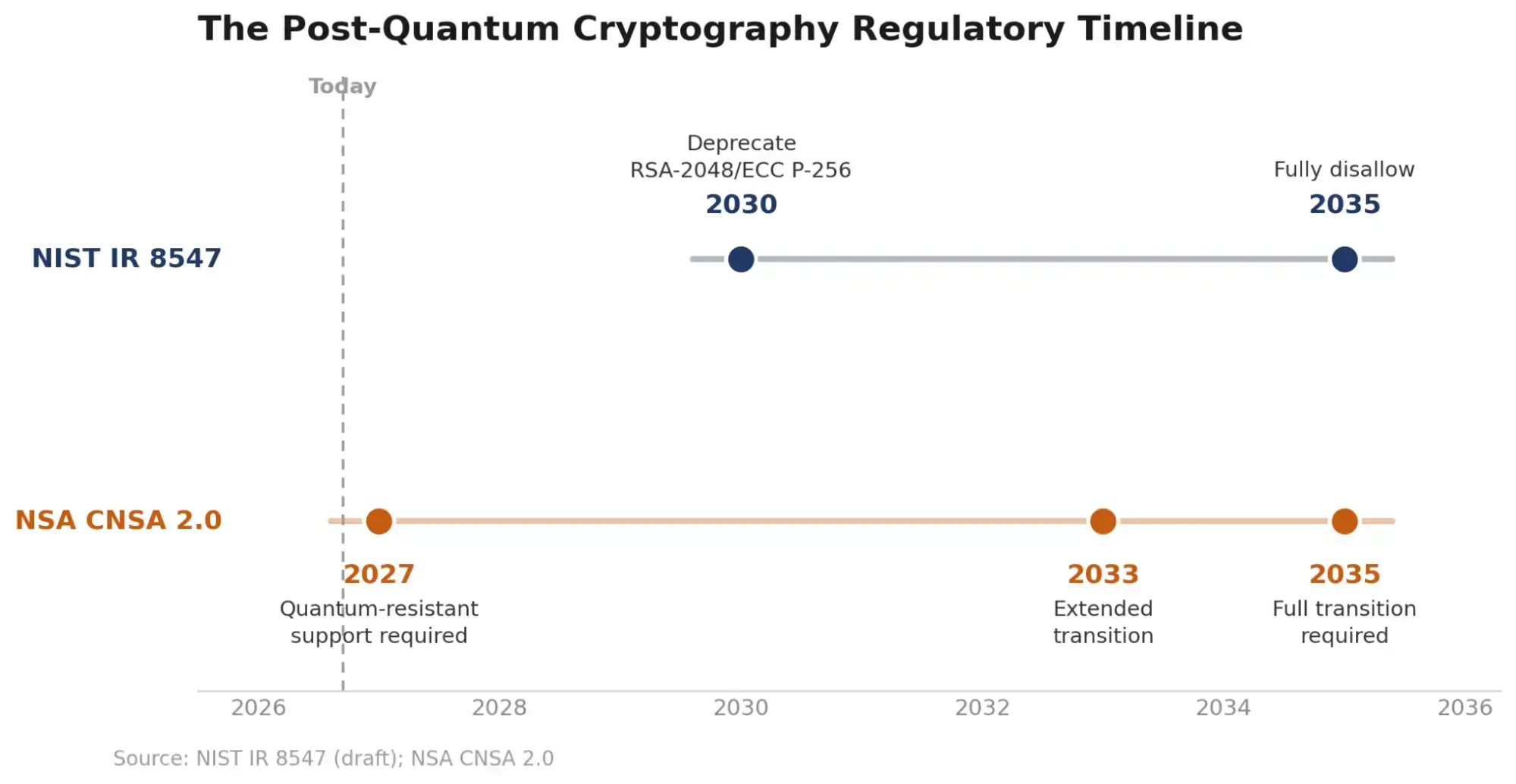
The Post-Quantum Cryptography Regulatory Timeline
The important point here is that even before you are required to meet the deadline, you have to make sure that your vendors are already working on providing better locks to your data, so to speak.
Why?
Because your insurance company is going to start asking about the new security protocols too. And assuming that your vendors are working on it is not enough.
The transition needs you to work with your vendors and the government. Make the right effort. Get ready for the transition yourself as well. You surely are not part of IBM’s 2025 quantum-safe readiness research, are you?
The Readiness Gap: In the Data
Most people working in the security department already sense there’s a problem.
A 2025 poll found that 62% of tech professionals are worried that quantum computers could eventually break the encryption protecting our data today.
But is worrying about the future enough?
Nope.
Businesses have to do something about it. And not many are thinking about this.
According to research data, 41% said they have no plan in place, and 37% said their company hasn't even talked about it internally yet.
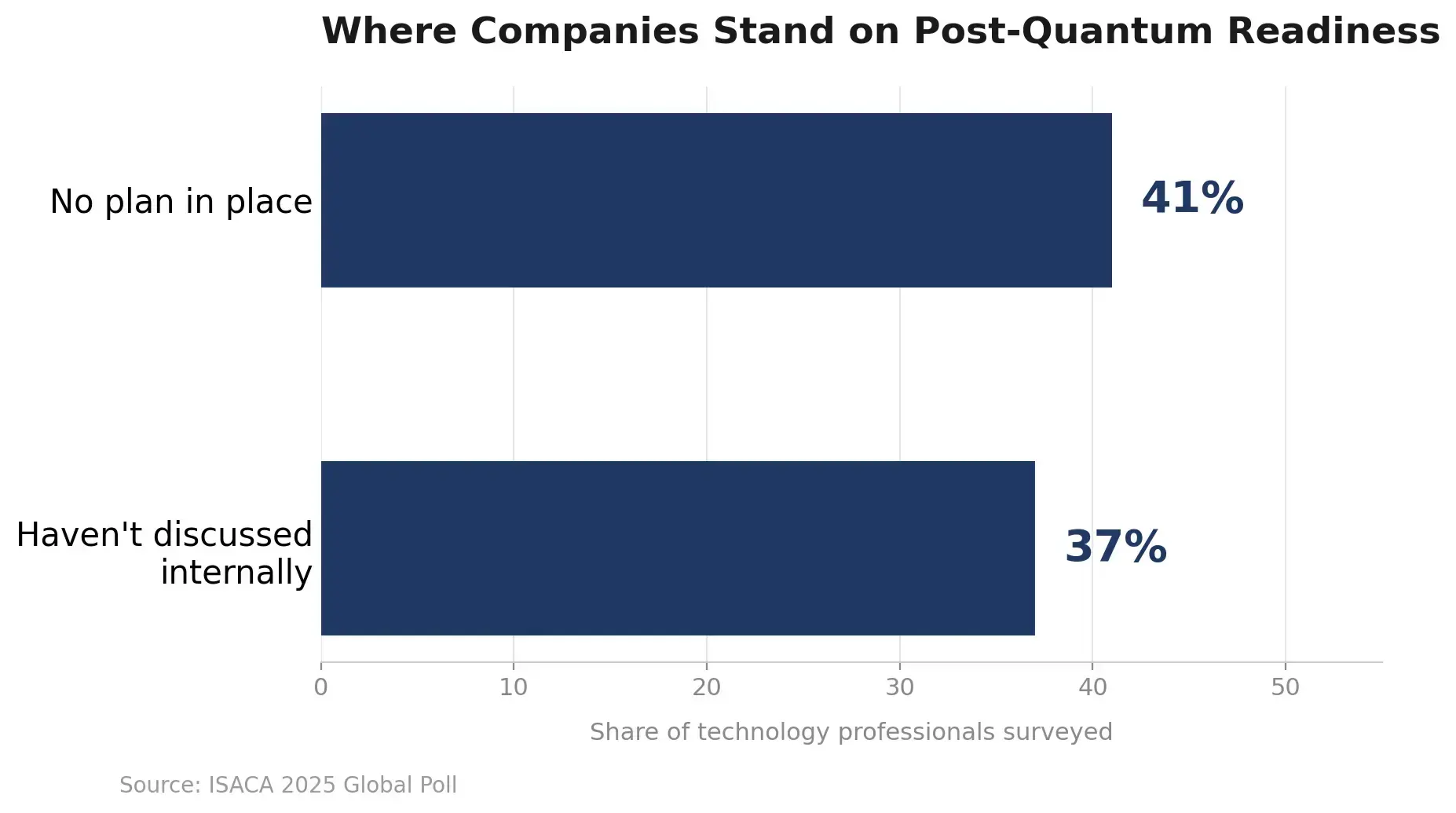
Where Companies Stand on Post-Quantum Readiness
IBM tried to measure this gap directly.
What did they do?
Well, they gave scores to companies.
Based on what?
Well, the scores were based on how well prepared these companies are for the shift, out of 100.
The average score in 2025 was just 25.
That doesn't mean companies are doing something dangerous. On the contrary, it means people know the risk is coming, but action hasn't caught up with the awareness yet. And this is a big problem.
Let’s Make It Simple!
Here's a simpler way to see the same problem in practice.
Every company uses digital “certificates.”
A certificate is a small piece of code that works like ID cards, letting computers prove to each other that they can be trusted.
There was research done by Sectigo. It basically found out that only 28% of companies actually have a full list of all their own ID cards.
Just 5% have a system that updates and replaces them automatically.
And the majority? Most are still doing it by hand, if they're doing it at all.
Why does this show up at basically every company? Not because people are careless. It's because encryption is invisible.
It means that the encryption is buried inside old systems, connected devices, network equipment, and code written by employees who left the company many years ago.
Most companies simply don't have a full, current picture of everything they're running.
That's the real risk right now. You need to fix this problem RIGHT NOW. Contact our experts here for more details. This is basically a first step in preparing for when quantum computers will start decrypting everything they can.
So, big businesses and small and medium-sized companies start working on getting quantum-ready by finding out what's actually there.
Real-World Snapshots
1. Banking
Banks have to hold onto records for a long time. For example, for checking loan history, banks store your ID checks from when you opened your account. Even after a decade, it happens.
That means whatever protects that data today has to keep working years from now too. So basically, banks are already working on both old and new encryption (including the quantum-resistant one) side by side.
Hint: Security checks, audits, payment cards, etc.
2. Healthcare
A medical record needs to stay private for a patient's entire life, not just a few years. And if data is any indication, this sector is the one that already gets hit harder financially by breaches than any other industry. IBM’s 2025 report on data breaches and their costs confirms this.
The tricky part?
Well, you have seen machines like heart monitors and MRI machines, etc., right? That is where patient records stay, encrypted.
3. Government & Defense
The clearest mandate. NSA’s CNSA 2.0 timeline governs national security systems directly and cascades to defense contractors and vendors; this is the one sector where the deadline isn’t up for interpretation. It is super straightforward and proceeding on a timer.
The Bottom Line
This doesn’t require buying a quantum computer or panicking your board. The post-quantum cryptography standards exist, the roadmap is documented, and the organizations ahead of the curve are simply the ones who treated cryptographic inventory as routine IT hygiene and started early.
The single action that moves you from “aware” to “prepared” is the same across every industry: start with a cryptographic discovery assessment. Everything else on the roadmap depends on knowing what you actually have.
Where Tycoonz Solutions Creates Impact
We’re not here to sell urgency: you have enough of that already.
What we offer is a starting point for your organization, which is a start to fighting quantum computers. We help you understand where you stand before you even commit a budget or timelines to anything else.
If you’re a risk, compliance, or IT leader trying to figure out where your organization sits on this roadmap, we’d welcome a conversation. Reach out to Tycoonz Solutions to get a 5-phase migration map for Post-Quantum Cryptography.
Along with PQC, our cybersecurity and AI services offer the right combination to assist your company the right way, at the right time.
To learn more about our services, Book a Call with our experts
